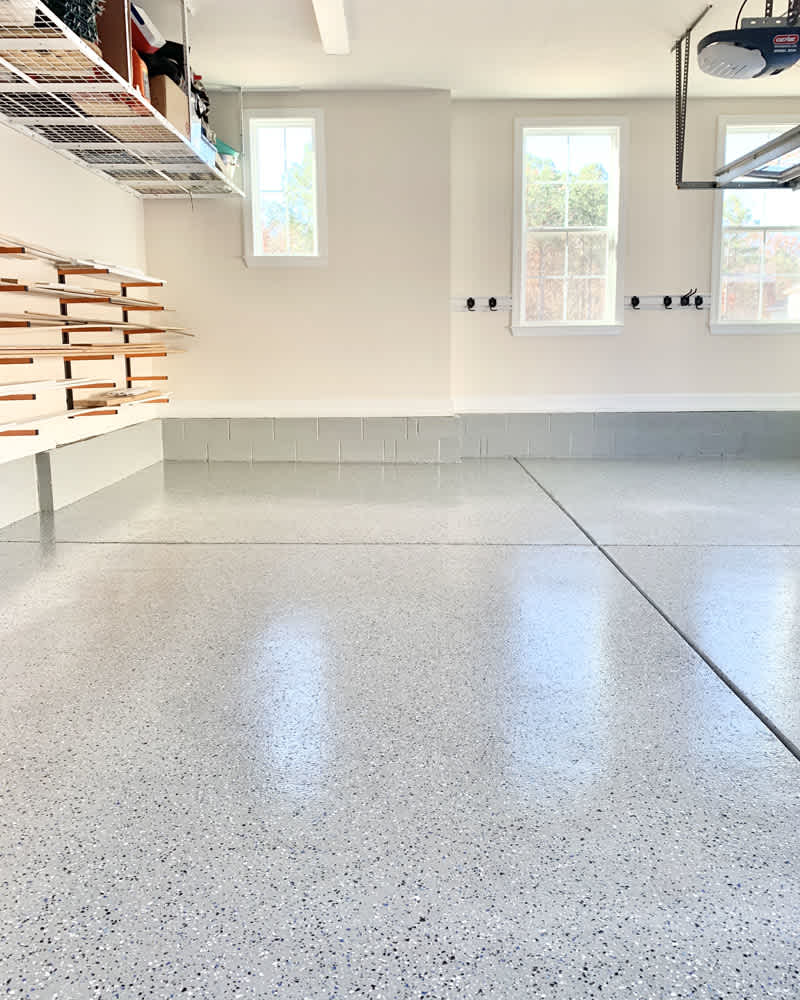
"Epoxy flooring" is a broad term — and the differences between systems matter. The thin water-based kit you'd buy at a big-box store and a true 100% solids high-build epoxy installed over a properly prepped slab are completely different products with completely different lifespans. This page walks through what real epoxy flooring is, where it works best, and what to expect for an Elizabethtown project.
Who epoxy flooring is best for
Solid-color and high-build epoxy systems are most often the right answer when the space is:
- Indoors and not in direct sunlight (basements, shops, utility rooms, mechanical rooms)
- A working surface that needs chemical and abrasion resistance more than decorative appeal
- A larger commercial space where cost-per-square-foot matters and a pure poly system is overkill
- An older slab that needs a thicker film to bridge minor surface imperfections
For garages and outdoor coatings, we usually recommend a polyaspartic-topcoated system instead — see the garage floor coating page for that conversation.
The main types of epoxy systems
100% solids epoxy
This is the workhorse of real epoxy flooring. No solvent, no water carrier — what you mix is what cures. It builds a thick, hard film (often 10–25 mils per coat), takes color uniformly, and has excellent chemical resistance. It's the right base for most commercial and industrial work.
Water-based epoxy
Thinner, easier to apply, less odor — and far less durable. Has a place as a primer or for very light-duty interior surfaces, but not what you want as the wear coat in a working space.
Solvent-based epoxy
Thinner film than 100% solids and more limited in modern installs because of VOC and odor concerns. Still used in some specialty applications.
Self-leveling epoxy
Used to flatten imperfect slabs or create seamless flooring in commercial settings. Pours like a thick liquid and finds its own level. Can be left as a smooth solid color or used as a base for decorative quartz or flake systems.
Mortar-grade epoxy
Heavy-duty system mixed with aggregate. Built for severe-service floors — manufacturing, mechanical rooms with vibration, areas with regular impact. Overkill for residential, essential for some commercial work.
Common Elizabethtown applications
Basements
Finished and unfinished basement floors in Elizabethtown homes coat well with high-build solid-color epoxy. The keys are moisture testing first (Hardin County humidity and the older slabs in town can both be issues), proper mechanical prep, and choosing a moisture-tolerant primer if the calcium-chloride test runs hot.
Workshops and hobby spaces
Detached shops, hobby garages, and converted outbuildings benefit from a simple high-build epoxy more than anywhere else. The film does the talking — protection from oil, paint, solvents, and dropped tools — and you don't need the decorative chip look.
Mechanical and utility rooms
Furnace rooms, water-heater rooms, and laundry rooms get a meaningful upgrade from epoxy. Dust suppression alone is worth it in a room where you don't want concrete particles getting into HVAC.
Light commercial
Smaller commercial spaces — retail stockrooms, breakrooms, smaller shops, mechanical rooms in office buildings — pair well with a sealed solid-color epoxy. For full retail floors and customer-facing areas, see the commercial service page.
The install process
- Site assessment. Slab condition, moisture levels, existing coatings, intended use.
- Mechanical prep. Diamond grinding or shotblasting to open the concrete profile (CSP 2–3 is the typical target for high-build epoxy).
- Crack and joint repair. Polymer or rigid fillers depending on whether the joint will move.
- Primer. Moisture-tolerant primer where needed; standard epoxy primer otherwise.
- Basecoat. Pigmented 100% solids epoxy applied at the spec'd film build.
- Optional broadcast. Quartz, flake, or color chip can be broadcast for texture and decoration.
- Topcoat. A clear finish coat — epoxy clear for indoor wear, polyaspartic or urethane where UV or chemical resistance matters more.
Local considerations
Slab moisture in basements
Older basements in Elizabethtown, especially in homes built before modern vapor barriers were standard, can have ongoing moisture vapor emission through the slab. Skipping moisture testing on a basement install is the single biggest reason failed coatings end up needing to be ground off and redone. A moisture-tolerant primer adds cost up front but pays for itself in not having to do the floor twice.
Concrete age
New concrete needs to cure before coating — typically 28+ days. Newer construction in subdivisions like Heartland Park, Cherokee Hills, or out toward Glendale sometimes wants a coating right after a slab pour, which usually means waiting a few weeks before grinding can start.
Temperature window
Standard epoxies cure best between 60–85°F. In an unconditioned space, that means scheduling around the season — late spring through early fall is ideal for unheated detached garages and shops in Hardin County.
Cost factors
Real epoxy flooring estimates depend heavily on the prep needed. We don't quote prices on this site, but here's what moves the number on a quote:
- Square footage (larger jobs are usually cheaper per sq ft)
- Surface profile of the existing slab and how much grinding is required
- Mil thickness of the spec (a 30-mil system costs noticeably more than a 12-mil)
- Color (custom and metallic colors cost more than standard)
- Topcoat type (polyaspartic or urethane add cost over an epoxy clear)
- Repairs needed for cracks, spalls, and joint chipping
- Moisture mitigation if the slab tests high
Timeline factors
Most residential epoxy projects in the Elizabethtown area run 1–3 days on-site, with cure time stretching the full project across a week. Commercial projects scale with square footage and downtime requirements (some commercial owners need overnight or weekend work to avoid disrupting operations).
Repair, recoat, or replace?
If you've got existing epoxy that's looking tired, the right answer depends on what's actually failing:
- Topcoat is dull, scratched, or yellowed: often just a screen-and-recoat away from looking new.
- Color coat is showing through worn spots: a topcoat refresh works if the underlying coat is sound.
- Coating is delaminating from the slab: prep failure; full removal and reinstall.
- Bubbling, blistering, or wet spots after recoats: moisture problem that has to be solved first.
See the repair, recoat, and rescue page for more detail on diagnosing a failing floor.
Questions to ask before you accept an estimate
- What product line and brand are you installing?
- Is this 100% solids epoxy, or a thinner system?
- What's the total spec'd mil thickness?
- How is the slab being prepped? (Acid wash is usually a red flag.)
- Will moisture testing be done before primer goes down?
- What's the topcoat? (Epoxy clear, polyaspartic, urethane?)
- How long until the floor is back in service?
Have a basement, shop, or commercial floor to coat?
Request My Free EstimateRelated services
- Garage floor coating
- Flake floor systems
- Metallic epoxy
- Concrete sealing (for outdoor and decorative concrete)
- Commercial floor coating
Epoxy flooring FAQs
How long does an epoxy floor last?
A properly prepped, properly spec'd 100% solids system in an indoor environment can last well over a decade in residential use. In commercial settings, lifespan depends on traffic and chemical exposure, but 7–15 years is realistic for many spaces.
Is epoxy slippery when wet?
Smooth solid-color epoxy can be slick when wet. For wet-area or kitchen applications, an anti-slip aggregate or texture additive should be added to the topcoat. Flake and quartz broadcast systems naturally have grip from the texture.
Will epoxy crack if my slab cracks?
Hairline cracks are usually bridged by the coating with no issue. Active, moving cracks (control joints, structural cracks) can telegraph through. Quality installers fill control joints with a flexible sealant rather than rigid epoxy so the joint can keep moving without fracturing the coating.
Can I install epoxy myself?
You can buy DIY kits, but the failure rate is high. Without diamond grinding, the coating bonds to the surface skin of the slab rather than the concrete itself, and it tends to peel within a year or two. For a long-lasting floor, the prep equipment is what makes the difference.