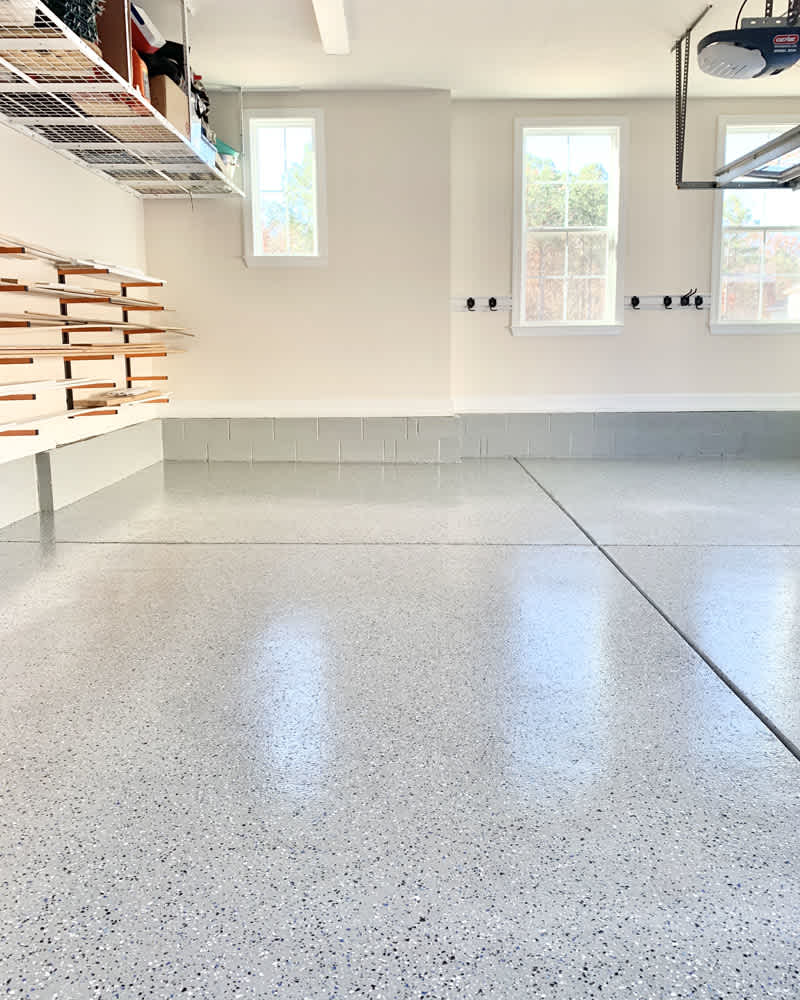
Failing garage coating, peeling epoxy, or hot-tire pickup in Elizabethtown? Start here.

If your existing epoxy or concrete coating is bubbling, peeling, lifting under tires, chalking, or losing color, you don't necessarily need a full tear-out. Most failed coatings around Elizabethtown can be diagnosed, mechanically prepared, and recoated with a system that's actually rated for the conditions you have. The key is figuring out why it failed before any new product goes down — otherwise the new coating will fail the same way, just on a slower clock.

This page walks through the most common failures we see on residential garage floors, basement slabs, shop floors, and commercial concrete in Elizabethtown, Radcliff, Vine Grove, and the surrounding Hardin County and LaRue County area, plus what a typical repair or recoat scope looks like.

Common coating failures we see locally

Hot-tire pickup

You park, you walk inside, and an hour later there's a tire-shaped patch of coating stuck to the rubber. Hot-tire pickup is the single most common failure on bargain DIY garage kits and on builder-grade single-coat epoxy applied without a primer. Tires get hot, they soften the coating, and as they cool they bond to it harder than the coating bonds to the slab. Solution: full mechanical removal of the failing layer, diamond grinding to a CSP-2 to CSP-3 profile, and a polyaspartic or commercial-grade two-coat epoxy/polyaspartic system rated for hot-tire resistance.

Peeling, lifting, or sheet-style delamination

If the coating is coming up in big sheets that look like a sticker peeling off, the bond between coating and concrete failed. The cause is almost always one of three things: no surface prep (a coating rolled directly onto smooth, sealed, or dirty concrete), trapped moisture vapor pushing up from below, or a contaminated slab (oil, silicone, old curing compound). A repair scope here usually means stripping or grinding the bad area, moisture-testing the slab, and selecting a primer or moisture-mitigation primer that matches what the slab is actually doing.

Bubbles, blisters, and pinholes

Tiny pinholes or bigger blisters in the surface usually mean outgassing — air trapped in the concrete pores escaped while the coating was curing. This is most common on garages poured in summer heat, on slabs without a proper vapor barrier underneath, and on coatings applied in afternoon sun when the slab temperature was rising. The fix depends on severity. Light pinholing can sometimes be sanded and topcoated. Widespread blistering usually needs the affected area ground off and recoated with a slower-cure primer applied during a falling slab temperature.

Chalking, fading, and yellowing

Standard epoxy is not UV-stable. If your garage door stays open a lot, or the coating runs out onto a porch or patio, you'll see the surface chalk and yellow over time — especially on whites, grays, and lighter metallics. The fix is typically a UV-stable polyaspartic or aliphatic urethane topcoat over the existing surface (after light grinding or chemical bonding prep). You don't always have to remove the original epoxy; in many cases the color coat can stay and a new clear topcoat re-locks the surface.

Cracks reappearing through the coating

If a hairline or structural crack telegraphs through your floor coating within a year, the crack was either not properly chased and filled before coating, or the slab is still moving. Static cracks can be V-cut, filled with a flexible polyurea joint filler, broadcast over, and recoated. Active cracks (slab still settling, control joint heaving) need to be addressed differently and sometimes need a flexible decorative chip system that can hide minor movement.

Stained, dull, or ugly concrete that was never coated

Plenty of Elizabethtown homeowners reach out about a basement, shop, or garage that has bare concrete that's stained, sealed years ago with something that's now flaking, or has a spotty rust-colored patina from old vehicle drips. This isn't really a repair — it's a fresh coating job — but the prep matters more than usual because the slab has history. Expect grinding, degreasing, and possibly an oil-tolerant primer.

What a recoat or repair scope typically includes

Every project is different, but a normal residential recoat scope on a 2-car or 3-car garage in Hardin County looks roughly like this:

  1. Site assessment. Walk the slab, check for active moisture, check for active cracking, identify what coating is currently down (if any), and confirm whether the existing coating can be partially saved or needs full removal.
  2. Moisture testing. Calcium chloride or relative humidity probe testing on questionable slabs — especially basements, slab-on-grade pours, and any garage where the existing coating bubbled.
  3. Mechanical prep. Diamond grinding or shot blasting to remove the failing coating and open the concrete pores. Hand grinding around edges and corners.
  4. Crack and joint repair. V-cutting static cracks, filling control joints with semi-rigid polyurea, patching spalls and divots with a fast-cure repair mortar.
  5. Primer. Selected based on slab condition: standard epoxy primer for clean dry concrete, moisture-mitigation primer for slabs with vapor pressure, oil-tolerant primer for shop floors with old contamination.
  6. Color or design coat. Solid color, decorative chip broadcast (often called flake), metallic, or quartz, depending on what the floor needs to look like and how it will be used.
  7. UV-stable topcoat. Almost always a polyaspartic or aliphatic urethane, applied at the right mil thickness for the use case (heavier in commercial, lighter for residential interior).

When repair is the wrong answer

Be honest with yourself before you request an estimate: not every floor should be saved. If the slab is structurally compromised — heaving sections, large unstable cracks, persistent active moisture with no vapor barrier — then putting another expensive coating on top is just buying a delayed problem. A good local installer will tell you that, and may recommend slab repair, vapor mitigation, or in rare cases breaking out and re-pouring a section before coating. A bad installer will quote you a recoat anyway.

Cost factors for repair and recoat work

Repair and recoat pricing in Elizabethtown is driven by these inputs more than anything else:

  • How much existing coating has to come off. A small isolated peel zone is far cheaper than a full strip of a 600 sq ft garage.
  • Slab condition under the failing coating. Clean concrete recoats fast. Oil-soaked, cracked, or spalled concrete adds prep time.
  • Moisture mitigation. If the slab needs a moisture-mitigation primer, that adds cost — but skipping it is the #1 reason recoats fail again.
  • System selected. Polyaspartic-over-epoxy with full chip broadcast costs more per square foot than a simple solid-color epoxy refresh.
  • Access. Basements, second-floor commercial space, and tight pool decks take longer to prep than a wide-open shop floor.

Anyone who quotes you a flat per-square-foot price over the phone, without seeing the slab, is gambling. Real estimates require a site visit or detailed photos plus slab history.

Timeline expectations

A standard residential recoat with a polyaspartic system can be a 1-day or 2-day project once the slab is prepped. Allow another day for grinding and crack repair if the existing coating is fully failing. Polyaspartics return a floor to foot traffic in roughly 4–8 hours and to vehicle traffic in 24–48 hours, depending on temperature. Slower-cure epoxy systems may require 24–72 hours before vehicles return. Basements and humidity-controlled interior spaces can sometimes be coated year-round; exterior porches, patios, and pool decks are weather-dependent.

Questions to ask before authorizing a repair

  • What test will you use to confirm the slab is dry enough to recoat?
  • Are you grinding the slab or just chemically etching it? (Grinding is almost always the right answer for a recoat.)
  • What primer are you using and why that one for my slab?
  • Is the topcoat UV-stable? (Yes for any garage that opens to sunlight, any porch, any pool deck.)
  • Are control joints being honored, filled, or coated over? (Usually filled with polyurea.)
  • What's the warranty and what voids it?
  • How long until I can park on it?

Related services

If your floor is failing and you're not sure what to do next, send the project details using the form on this page. Include square footage, the year and brand of the existing coating if you know it, and a couple of photos in the description box. We'll match your request to a local installer who can give you an honest read.