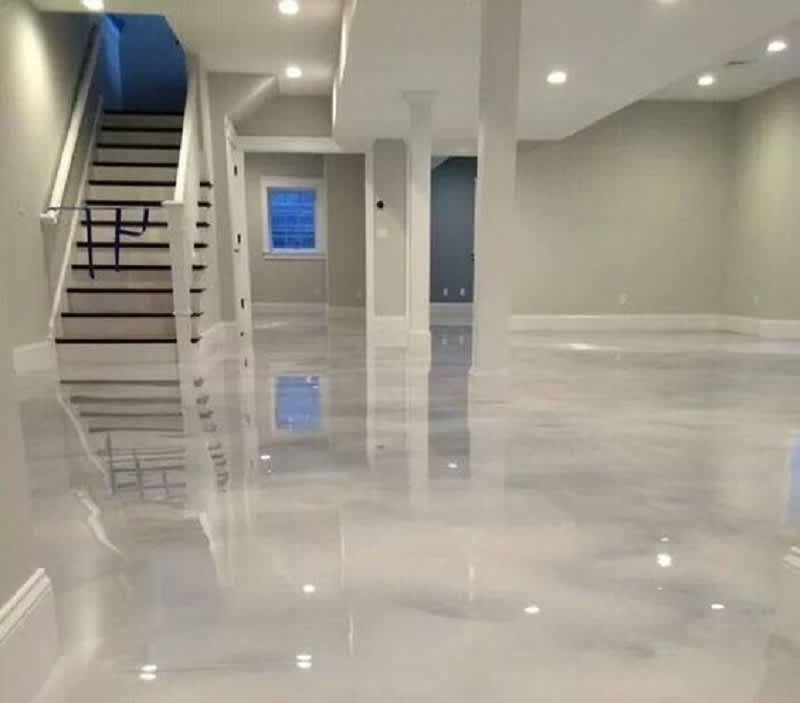
Metallic epoxy is the floor that makes people stop in the doorway. Pearlescent pigments suspended in 100% solids epoxy create a flowing, three-dimensional pattern that resembles polished stone, marble, or molten metal — depending on the colors and the technique. No two floors look the same, and that's the point.
Who metallic epoxy is best for
Metallic floors are usually the right choice when:
- You want a high-end, decorative look that stands out from a standard flake or solid-color floor
- The space is indoors and not subject to UV from direct sunlight
- The floor is a feature space — a finished basement, a man-cave, a retail showroom, a spa or salon
- You're willing to pay a premium for a finished surface with no two patterns alike
Metallic systems are not the right choice for hard-use commercial floors with rolling forklifts, shop floors with steel or sharp tooling, or sun-exposed exterior surfaces. For those, look at commercial coatings or a flake system.
How a metallic floor is built
The base mechanics are similar to other epoxy systems, but the application is what makes it look the way it does.
- Diamond grinding — same prep standards as any quality epoxy installation
- Crack and joint repair — patched and ground flush before basecoat
- Pigmented base — solid color basecoat (often black or charcoal for depth, but white, pearl, and custom shades are common)
- Metallic pour — a clear epoxy mixed with metallic pigment is poured and worked across the basecoat, sometimes with multiple colors blended in
- Manipulation — the wet metallic layer is moved with brushes, rollers, blowers, leaf blowers, or solvent drops to create the unique pattern
- Cure — the metallic coat needs full cure before topcoating
- Clearcoat — a UV-stable polyaspartic or aliphatic urethane clear protects the metallic and locks in the depth
The whole system is typically 30–60 mils thick when finished, depending on how heavy the metallic pour is.
Color and pattern options
Metallic epoxy comes in dozens of pigment colors, and they can be combined. Common requests in this market include:
- Black + silver — looks like polished granite or wet asphalt with light playing across it
- White pearl + champagne — soft, marble-like, popular in salons and bridal spaces
- Copper + bronze + black — warm, dramatic, often seen in restaurants and basement bars
- Blue + silver — water-like, popular in pool houses and themed basements
- Single-color metallics — slate, charcoal, bronze, or pearl as a more subdued, monochrome look
Because the pattern emerges during the pour, the installer's technique matters enormously. Ask to see photos of multiple installs by the same person — not just stock images from the manufacturer.
Common Elizabethtown applications
Finished basements
The most popular residential application. A metallic floor turns a finished basement into a designed space rather than "the basement." Pairs well with finished walls, recessed lighting, and a basement bar build.
Showrooms and retail
Smaller retail spaces in and around Elizabethtown — boutiques, salons, gyms, specialty shops — benefit from metallic floors as a low-cost upgrade over polished concrete. The high-end appearance is genuinely useful for differentiating a customer-facing space.
Garages (with caveats)
Metallic in a garage can look spectacular, but it shows tire wear faster than a flake floor and can be slick when wet without an anti-slip topcoat. If you want metallic in your garage, plan on a UV-stable topcoat with anti-slip additive — and accept that it's a showpiece more than a daily-driver workhorse.
Restaurants, bars, and entertainment spaces
Restaurant and bar dining areas (not kitchens) take metallic floors well, especially in larger spaces where the floor pattern reads from across the room.
Local considerations
Sunlight and UV
Standard metallic systems use clear epoxy carriers that will yellow under direct sun. For any space with strong window light or sun exposure — a sunroom, a south-facing showroom — the topcoat must be polyaspartic or aliphatic urethane, and even then the metallic colors should be chosen to minimize the visible effect of any color shift over time.
Slab moisture
Same rule as any epoxy: a moisture-prone basement slab needs to be tested and primed properly. Metallic systems are unforgiving of moisture issues because any blistering shows immediately in the polished topcoat.
Lighting
Metallic floors look completely different under different lighting. A floor that looks deep and rich under warm LEDs may look flat under cool fluorescents. If lighting will change after installation, talk to the installer about color choices that work in both.
Cost factors
Metallic floors are usually the most expensive coating system per square foot of any common residential option. Drivers:
- Pigment cost (real metallic pigments are pricey)
- Labor — the pour and manipulation steps take longer than a flake broadcast
- Multiple colors and complex blends
- Two-coat clear protection
- UV-stable topcoats over standard epoxy clears
- Slab condition and prep work
Timeline factors
A metallic install is typically a 2–3 day project on-site, with the metallic pour, cure time, and clearcoat each needing their own day. Cure times push the floor's return-to-service to 24–72 hours after the final coat depending on temperature.
Repair and recoat
Metallic floors are harder to spot-repair than flake systems because the pattern doesn't hide repairs the way texture does. Common situations:
- Worn or scratched topcoat: screen and recoat with a fresh clear. Floor looks new.
- Damage to the metallic layer: usually requires a partial reinstall in the affected area, and the patch will not perfectly match.
- Yellowed clear from UV: strip and reapply UV-stable clear.
If you have a metallic floor that's failing, see the repair and recoat page for diagnostic guidance.
Questions to ask before accepting an estimate
- Can I see photos of 3–5 metallic floors you've personally installed?
- What pigments and brand are you using?
- What basecoat color goes under the metallic?
- How many clear coats, and what brand/type of clear?
- Is the topcoat UV-stable?
- Will anti-slip additive be included?
- What happens if I don't like the pattern? (Honest answer: you have to live with it or pay to replace it.)
Want a metallic floor in your basement, showroom, or feature space?
Request My Free EstimateRelated services
- Flake floor systems — alternative decorative finish
- Solid-color epoxy — utility and shop floors
- Garage floor coating
- Commercial coatings for retail and showroom spaces
Metallic epoxy FAQs
How is metallic different from regular epoxy?
Standard epoxy uses opaque pigments and looks like a single flat color. Metallic epoxy uses pearlescent or mica-based pigments suspended in a clear epoxy carrier, which the installer manipulates while wet to create depth, movement, and pattern.
Is metallic epoxy slippery?
The standard glossy topcoat can be slick when wet. For wet-area applications or floors near exterior doors, request an anti-slip aggregate or texture additive in the clearcoat.
Can I see exactly what my floor will look like before installation?
You can see color samples and reference photos of past installs, but the final pattern emerges during the pour and cannot be predicted exactly. If you need a specific predictable look, a flake system is a better fit.
Will it scratch?
The clearcoat is what protects the floor, and quality polyaspartic clears resist normal wear well. Heavy point loads (a dropped tool, a steel-wheeled cart) can scratch through the clear into the metallic layer. For high-wear use, consider a flake or commercial system instead.